If you have started looking into getting a website built, you have probably encountered this question already. Someone has mentioned WordPress. Someone else has mentioned a "custom built" or "bespoke" site. And if you are not a developer, the difference is not always obvious.
Here is a plain-English breakdown of what each actually means, what the real trade-offs are, and how to figure out which makes sense for your business.
What people mean by "WordPress"
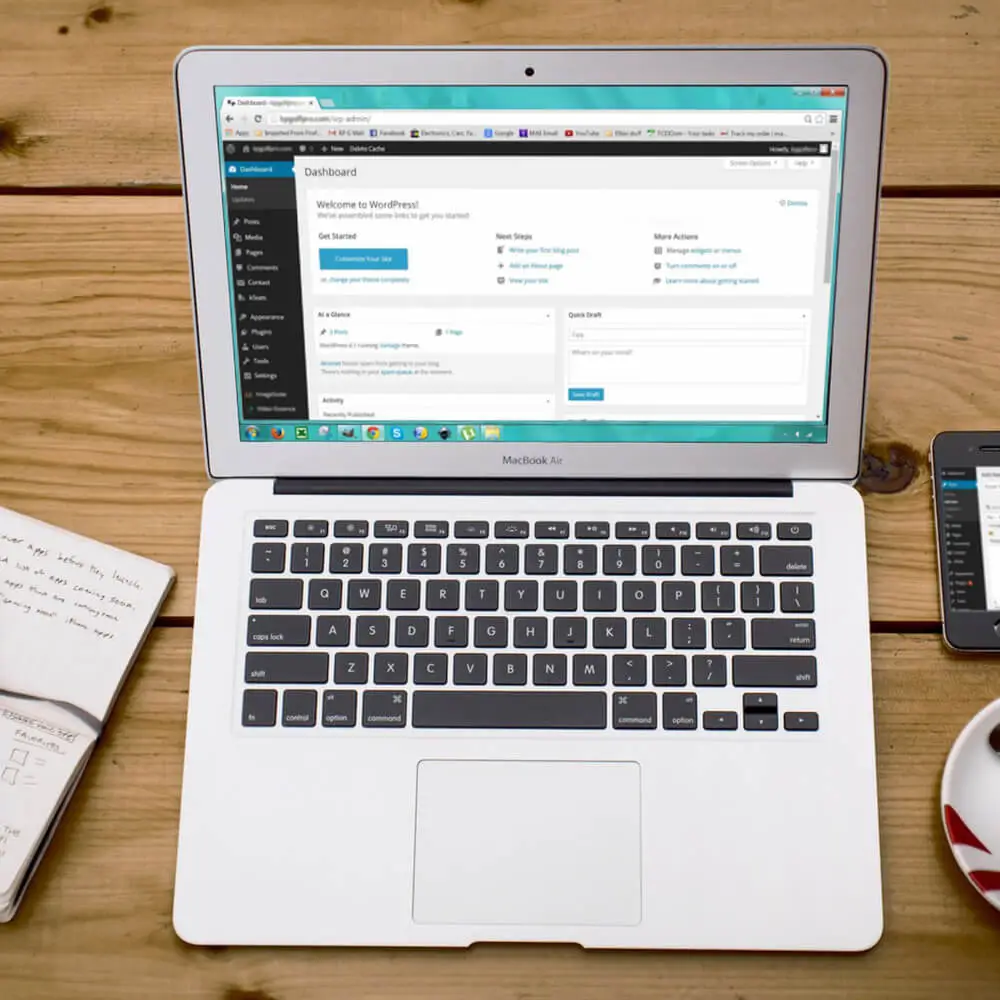
WordPress started as a blogging platform and has grown into the most widely used website platform in the world. It powers somewhere around 40% of all websites. Most people know it as the thing behind the dashboard where you log in and edit your pages.
What a lot of people do not realise is that there are two very different ways to build a WordPress site, and they produce very different results.
Off-the-shelf WordPress means buying or downloading a pre-built theme — a visual template that gives your site its look and feel — and customising it with your logo, colours and content. Many of the cheap and quick WordPress builds you see advertised work this way. It is fast and relatively inexpensive, but you are working within someone else's design and structure, and the same theme might be in use on thousands of other sites.
Custom WordPress means a developer builds your theme from scratch, specifically for your business. The CMS — the bit you log in and use to edit your content — is still WordPress, so you get all the familiarity and ease of use that comes with it. But the design, the structure, and the code are built entirely around what you need. Nothing is carried over from a template.
This distinction matters a lot, and it is often glossed over when people compare WordPress to bespoke development.
What people mean by "bespoke"
A bespoke website — sometimes called a custom web application — is built entirely from scratch without WordPress at all. Frameworks like Symfony or Laravel are commonly used to build these. There is no pre-existing CMS or admin dashboard unless the developer builds one as part of the project.
Bespoke development is typically used when a project needs something WordPress cannot provide: a complex booking system, a customer portal, a platform with custom user roles and workflows, or performance requirements that a traditional CMS cannot meet. The flexibility is total, but the cost and build time reflect that.
The option most businesses actually need
Here is where the real conversation usually lands. For the majority of small businesses — a service company, a local retailer, a professional practice, a hospitality business — the right answer is neither a cheap off-the-shelf WordPress theme nor a full bespoke application.
It is a custom-built WordPress site.
You get a design and structure built specifically for your business. You get a CMS that is genuinely easy to use and that you can manage yourself without a developer. You get the vast ecosystem of WordPress — including security updates, compatibility with tools you might already use, and a platform your staff are likely already familiar with.
What you do not get is the weight and bloat that comes with a site assembled from multiple third-party themes and plugins, or the constraints of working inside a template someone else designed.
When a fully bespoke build makes sense
There are situations where WordPress genuinely is not the right tool. If your project involves any of the following, it is worth having a conversation about a fully custom solution:
- Complex user accounts or portals — customers logging in to manage bookings, orders, or account data
- Custom workflows — applications that need to do things in a specific sequence that no off-the-shelf plugin can replicate
- High-volume or high-performance requirements — platforms that need to handle significant traffic or complex database queries at speed
- Deep third-party integrations — connecting to APIs, internal systems or data sources in ways that require custom-built connectors
For most small businesses, none of this applies. But when it does, the right framework — Symfony or Laravel, for example — will outperform WordPress in ways that matter.
What about cost?
The cost difference between an off-the-shelf theme and a custom build is real. A site assembled from a purchased theme can be put together quickly and cheaply. A custom-built WordPress site takes longer and costs more because the work is genuinely bespoke.
What is worth weighing against that cost is what the cheaper option usually costs you later: a site that looks generic, loads slowly because of bloated theme code, and cannot easily be changed without breaking something.
A properly built site — custom WordPress or bespoke — is an investment that pays for itself if it is done well. One that ranks well in search, loads fast and converts visitors into enquiries does more commercial work than one that just exists.
You can find a breakdown of typical costs and what is included as standard in every build on the pricing page.
The short version
- Off-the-shelf WordPress: fast and cheap, limited in design and performance
- Custom WordPress: purpose-built design and code, with a CMS your team can use — right for most businesses
- Bespoke (Symfony / Laravel): total flexibility, higher cost and build time — right for complex applications
If you are unsure which category your project falls into, the honest answer is that most business websites — even ambitious ones — are well served by a custom WordPress build. A good developer will tell you clearly if your project genuinely warrants something else.
If you are based in Yorkshire and want to talk through what would work best for your project, get in touch and we can figure it out together.